Logic Apps
A recipe card that runs itself
Smart-home routine: trigger → steps. Consumption (serverless, pay-per-run) vs Standard (dedicated, stateful, VNet-integrated). Designer-centric orchestration.
Flashcards, honest positioning, concept analogies, headless/async patterns, and enterprise diagrams — practice aloud with audio.
Text-to-speech isn’t available in this browser. Try Chrome or Edge for audio.
Same integration patterns, different product names — use this when you claim multi-cloud fluency.
Talking point: I’m cloud-agnostic on the architecture. Queues, pub-sub, API façades, orchestration, and streaming are the same problems on Azure, AWS, and GCP — I map the tool to the pattern, not the brand.
| Capability | Azure (AIS) | AWS | GCP |
|---|---|---|---|
| API gatewayPerimeter, policies, developer portal | API Management (APIM) | API Gateway+ Amazon Cognito / WAF | Apigeeor Cloud API Gateway |
| Workflow orchestrationMulti-step business processes | Logic Apps | Step Functions+ EventBridge Pipes | Workflowsor Cloud Composer |
| Enterprise messagingQueues · ordered · DLQ · sessions | Service Bus Queues | SQSFIFO queues + DLQ | Pub/Subpull subscriptions |
| Pub-sub fan-outOne event → many consumers | Service Bus Topics | SNS+ SQS subscribers | Pub/Sub |
| Reactive event routingPush / webhook · CloudEvents | Event Grid | EventBridge | Eventarc+ Pub/Sub |
| High-throughput streamingIoT / telemetry / analytics ingest | Event HubsKafka-compatible | Kinesis Data Streamsor MSK (Kafka) | Pub/Subor Dataflow / Kafka on GKE |
| Serverless glueTransforms, custom connectors | Azure Functions | Lambda | Cloud Functionsor Cloud Run |
| API catalog / governanceEnterprise inventory & discoverability | API Center | API Gateway + Portalor AppRegistry patterns | Apigee API hub |
| Hybrid / on-prem bridgeNo inbound firewall holes | On-Premises Data Gatewayor VNet + ExpressRoute | Direct Connect / VPN+ PrivateLink / App Runner VPC | Cloud Interconnect / VPN+ Private Service Connect |
| Secrets & identityNo connection strings in code | Managed Identity + Key Vault | IAM Roles + Secrets Manager | Workload Identity + Secret Manager |
Closest functional mapping for interview talk-track — not 1:1 product parity. Lead with patterns (API-led versus event-driven, orchestration versus choreography), then name the cloud service.
Honest positioning for the Azure Integration Services Architect technical evaluation — lead with strength, name the gap cleanly.
Your opening line
If pushed on hands-on AIS depth
Map real experience to their questions
If asked: “Tell me about an integration project you led”
CHANEL — led a CDC-based ERP integration using Qlik Replicate, migrating D365 from on-prem to Azure SQL. Owned schema mapping, source-to-target transformation design, and downstream Power BI reporting integration.
If asked: “How do you approach integration architecture governance?”
TOGAF 9.2 certified — 20 years defining architecture standards, leading design reviews, producing blueprints and technical specifications for governance sign-off.
If asked: “How do you handle stakeholder alignment across teams?”
Career-long pattern — primary technical interface at Cathay Pacific for 13 years, across Enterprise Architects, Business Analysts, and Infrastructure teams simultaneously.
If asked: “CI/CD and IaC experience?”
AZ-400 certified. Real Git-based version control and structured release governance at Cathay Pacific across multi-environment deployments.
Plain-language intuition for the interview — review the cards, then the stateful vs stateless table.
A recipe card that runs itself
Smart-home routine: trigger → steps. Consumption (serverless, pay-per-run) vs Standard (dedicated, stateful, VNet-integrated). Designer-centric orchestration.
A post office, not a phone call
Queue = one mailbox. Topic = newsletter to subscribers. Sessions, DLQ, at-least-once — letter waits if nobody’s home.
A fire alarm, not a delivery van
Reactive push: “something happened.” Lightweight CloudEvents fan-out — not for high-value transactional cargo.
Building front desk & security
Badge check (auth), crowd control (rate limits), visitor log (monitoring), developer portal. Your APIM training belongs here.
Light that draws power only when on
Custom glue Logic Apps can’t express cleanly. Consumption / Premium / Dedicated. Pair with Durable Functions for code-centric orchestration.
Private road vs public highway
On-Premises Data Gateway (outbound-only). VPN Gateway = encrypted shared lane; ExpressRoute = private road to HQ.
Fitness tracker for the app
Requests, exceptions, dependencies — catch patterns before collapse. Pair with correlation IDs across APIM → Logic Apps → Service Bus.
Central security office
Every camera feeds one control room. Monitor = the operation; Log Analytics = searchable archive of every tape.
Stateful vs Stateless Logic Apps
| Feature | Stateful (Durable) | Stateless |
|---|---|---|
| State storage | External (e.g. Azure Storage) | In-memory |
| Max runtime | Up to ~1 year | ~5 minutes |
| Performance | Higher latency (checkpoints) | Ultra-low latency |
| Failure recovery | Resume from checkpoint | Restart from beginning |
| Primary use | Approvals, batch, long tasks | Real-time APIs, webhooks |
vs Durable Functions: same orchestration idea — Durable Functions are code-centric (C#/JS); Logic Apps are configuration/designer-centric.
APIM + Stateful Logic Apps for high-volume checkout — conceptual → logical → physical, plus mock transcript and policy sketch.
What is a headless API?
Backend data/content logic separated from what the user sees.
Same endpoints serve mobile, web, IoT, partners.
Usually REST or GraphQL delivering JSON/XML — clients never see ERP internals.
Conceptual · Logical · Physical
Business goal: omni-channel clients submit large orders without waiting for multi-step backends. Boundary: clients submit + poll status; unaware of ERP internals.
Ingress validates tokens and shapes contracts. Stateful orchestrator sequences steps + retries. Connectors translate to ERP and notification engines.
APIM Premium multi-region; Logic Apps Standard stateful + Storage; VNet + private endpoints so backends aren’t public.
Async request-reply flow
Interview talking point — normalise async responses and correlation IDs. Replace domain for demo.
<policies>
  <inbound>
    <base />
    <rate-limit-by-key calls="100" renewal-period="60"
      counter-key="@(context.Request.IpAddress)" />
    <set-header name="X-Correlation-ID" exists-action="override">
      <value>@(context.RequestId.ToString())</value>
    </set-header>
  </inbound>
  <backend><base /></backend>
  <outbound>
    <base />
    <choose>
      <when condition="@(context.Response.StatusCode == 200 || context.Response.StatusCode == 202)">
        <set-status code="202" reason="Accepted" />
        <set-header name="Location" exists-action="override">
          <value>@($"https://yourdomain.com/status/{context.RequestId}")</value>
        </set-header>
      </when>
    </choose>
  </outbound>
  <on-error><base /></on-error>
</policies>
Walk me through a headless architecture using APIM and Logic Apps for high-volume checkout.
Presentation is fully decoupled. Expose clean REST via APIM for mobile, web, partners. APIM owns auth, caching when safe, and throttling. Route orchestration to a stateful Logic App — checkout is multi-step (inventory, order, ERP, payment) so we need checkpoints and resume if a downstream is unavailable.
If the Logic App takes 30 seconds, won’t the frontend timeout?
Asynchronous request-reply at the APIM edge: acknowledge with 202 Accepted and a Location tracking URL. Client polls status; UI stays responsive while the durable workflow continues.
How would you explain physical vs logical deployment to a stakeholder?
Logically: API edge → process orchestration → systems of record. Physically: APIM Premium multi-region, Logic Apps Standard with Storage for state, VNet + private endpoints so ERP isn’t on the public internet.
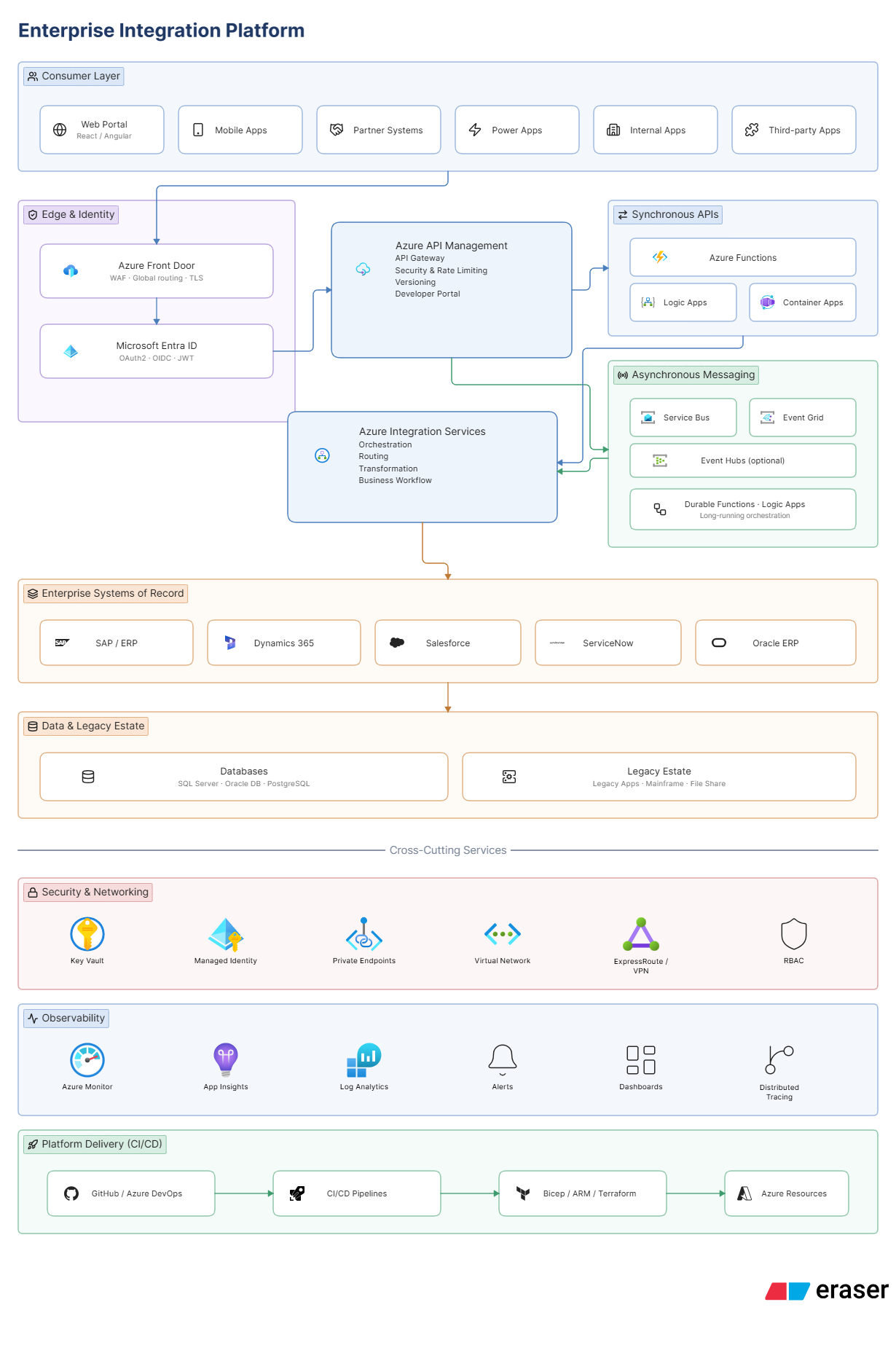
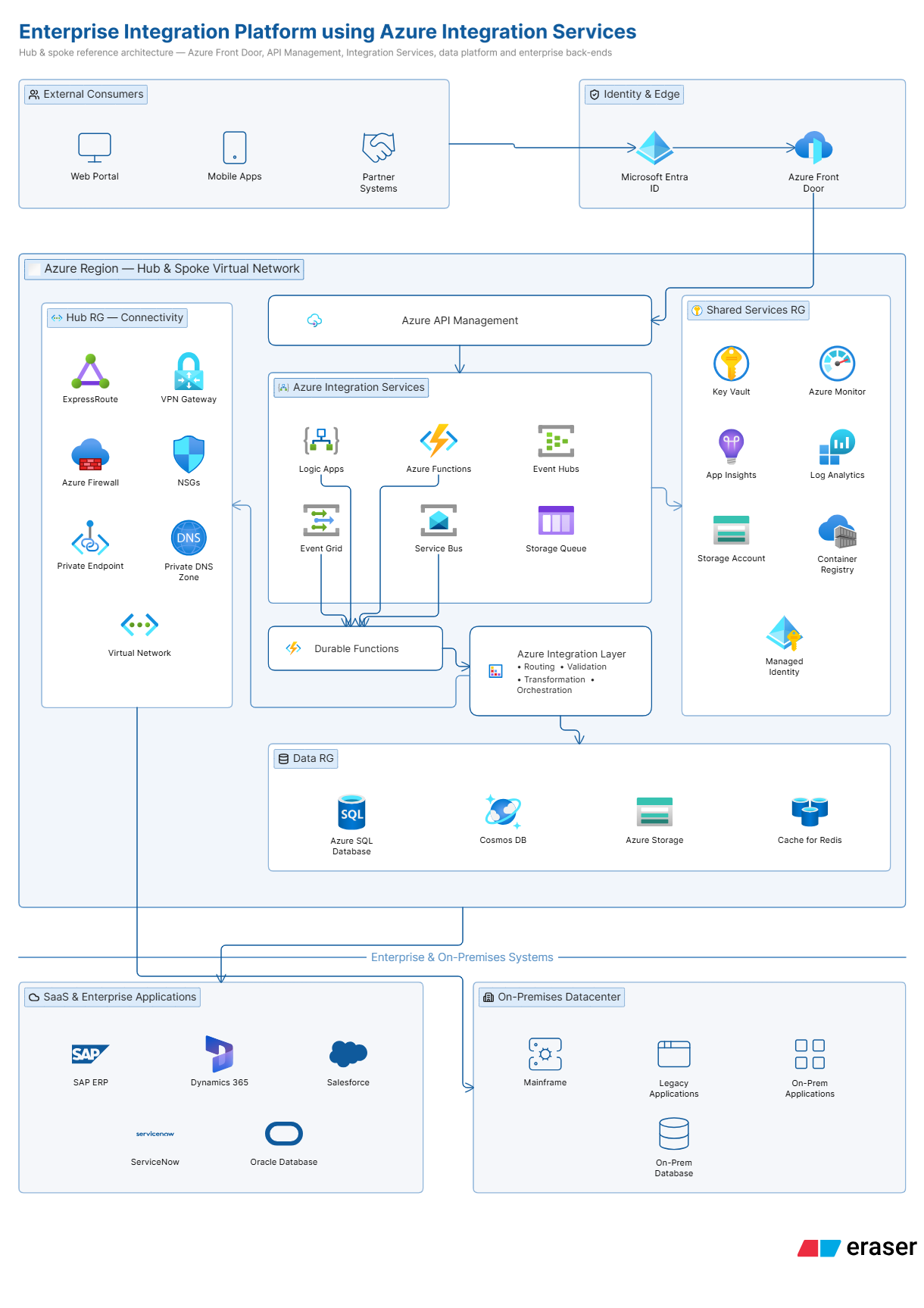
Reference architectures from your AIS prep folder — use these to narrate Hub & Spoke, sync vs async paths, and cross-cutting platform services.
Consumers → Front Door / Entra → APIM → sync (Functions / Logic Apps / Container Apps) vs async (Service Bus / Event Grid / Event Hubs / Durable) → systems of record, with security, observability, and CI/CD underneath.
Identity & edge, Hub RG (ExpressRoute / VPN / Firewall / Private Endpoints), APIM, Integration Services (Logic Apps, Functions, Event Hubs/Grid, Service Bus), Shared Services, Data RG, plus SaaS ERP and on-prem estates.
Turn the interview into a two-way conversation — shows architectural judgment and contract mindset.